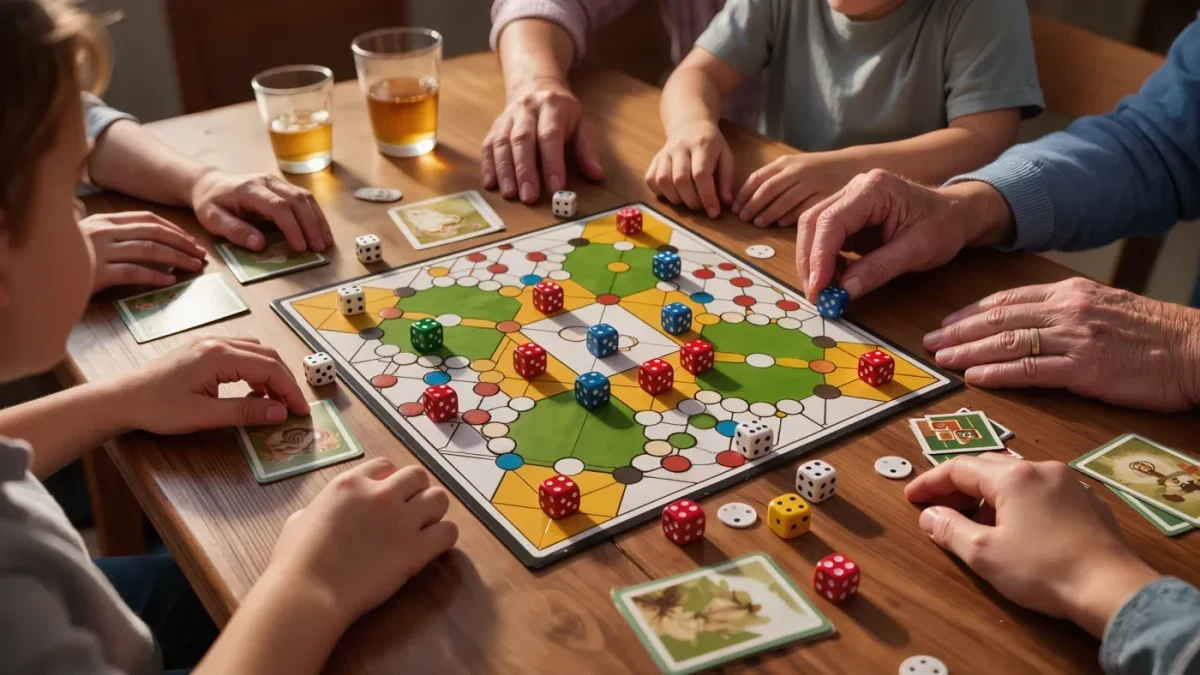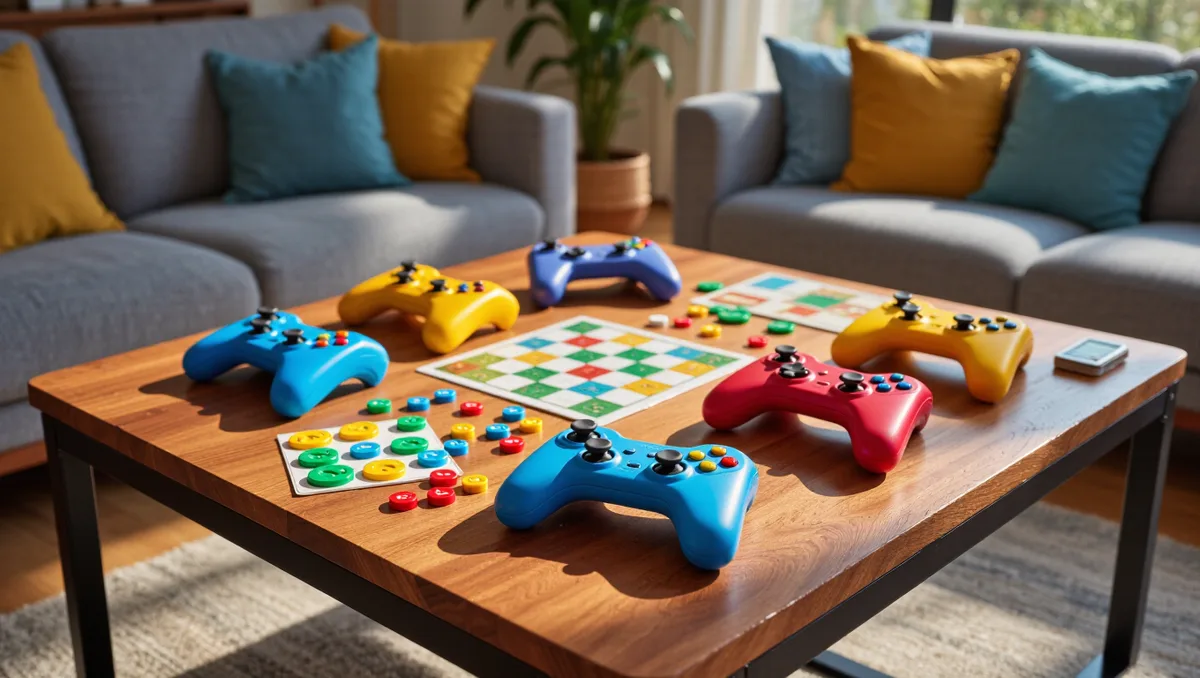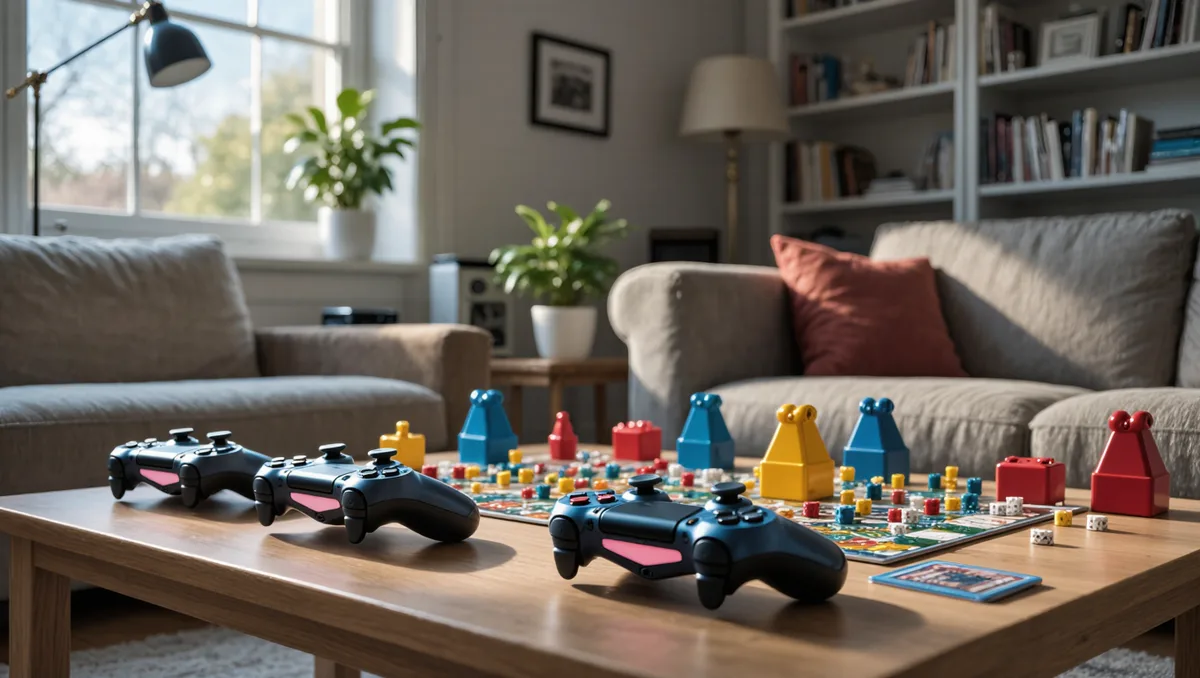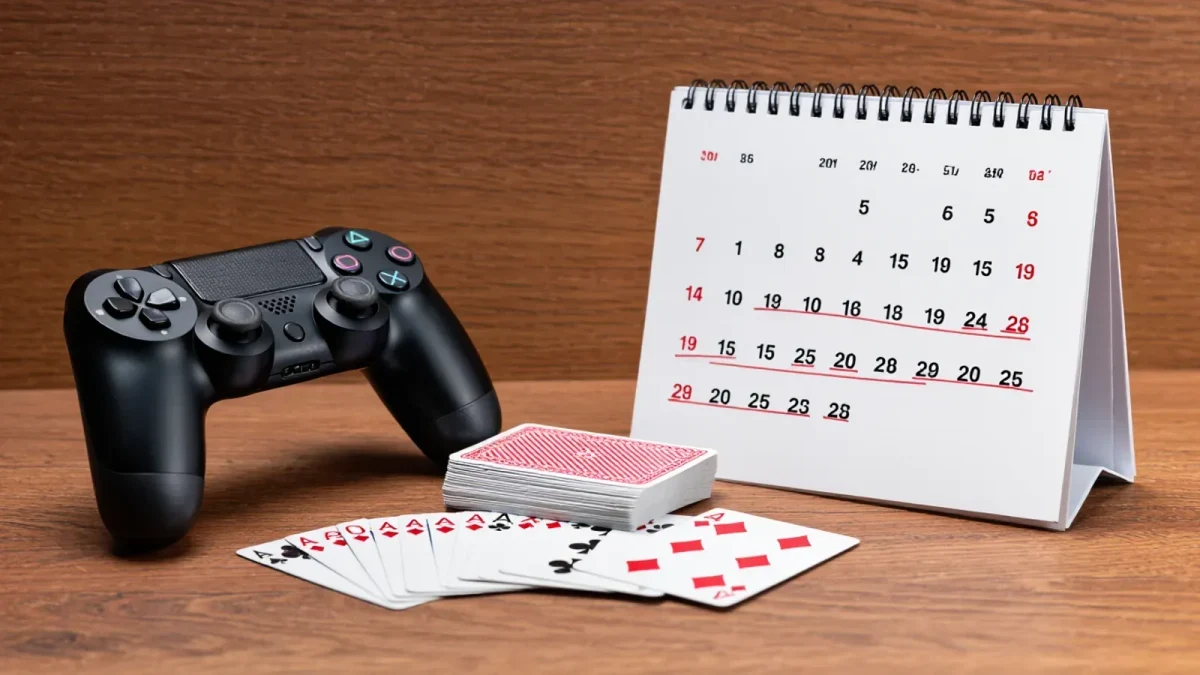
A family game night rotation works when it has three fixed parts: a protected weekly time slot (the single biggest predictor of whether game night survives past month two), a repeating four-week format cycle — co-op video game one week, board game the next, party or competitive night after that, family-choice wildcard to close — and a pick-order rule so every member, including the youngest, gets a guaranteed turn choosing. Families that fix all three keep the tradition for years; families that improvise each week usually lose the habit by spring. Here is how to build the version that sticks.
Why do most family game nights fizzle out?
Almost never because of the games. The three usual killers are scheduling drift ("we'll do it sometime this week" means never), marathon sessions that end in tears and bedtime fights, and one person — often a parent, sometimes an older sibling — always picking. A rotation fixes all three structurally: the calendar owns the time, a 60-90 minute session cap owns the ending, and the pick wheel owns fairness. The games are the easy part.
What does the four-week rotation look like?
The pattern alternates energy levels so no two adjacent weeks feel the same:
| Week | Format | Example | Energy |
|---|---|---|---|
| Week 1 | Co-op video game | Overcooked! 2 (E10+, 4 players) | High, collaborative |
| Week 2 | Board game | Ticket to Ride or Sushi Go! | Medium, conversational |
| Week 3 | Party/competitive night | Mario Kart 8 Deluxe (E, 4 players) tournament | High, competitive |
| Week 4 | Wildcard | Family-choice: anything on the shelf | Whatever the picker wants |
The wildcard week is not filler — it is the pressure valve. Anything the family owns is legal, including a re-run of week one's game or a movie-adjacent night. Rotations fail when they feel like a diet; the wildcard keeps it feeling like a menu.
How do you pick the night and protect it?
Pick the night with the fewest recurring conflicts — for most families Friday or Sunday — and defend it like a dentist appointment. Three rules make protection realistic:
- Same night, same start time, every week. A floating game night is a dying game night. Put it on the shared family calendar with a reminder.
- Hard stop declared at the start. Announce "we finish at 8:30" before play begins. Ending while everyone is still having fun is the oldest trick in event design, and it works on kids exactly as well as it works on adults.
- Sick/vacation rule decided in advance. If someone is absent, the show goes on with the people present; the rotation does not pause for a cold. Paused traditions restart badly.
How does pick-order work with different ages?
Keep a simple wheel: each week a different family member picks the game, cycling through everyone including parents. Two adjustments make it work with a spread of ages. Give the youngest picker veto-free support — a parent quietly co-picks to avoid a forty-minute rules disaster. And grant each picker one "no thanks" per cycle: if the picker chooses a game someone genuinely dislikes, that person may sit out one round with a snack job (scorekeeper, DJ, popcorn runner) instead of sulking through it. Participation with a role beats mandatory fun.
How long should each session be?
Match the cap to the youngest player's age: about 45-60 minutes for families with a child under 8, 90 minutes for tweens and teens. Structure the session in blocks — for example, a 10-minute warm-up card game (Taco Cat Goat Cheese Pizza), the main event, and a 10-minute wind-down round everyone can win. The warm-up matters more than it sounds: it gets the first loss of the night out of the way while stakes are low. Console parental controls with play-time limits, available on Switch, Xbox, and PlayStation, can enforce the video-game weeks automatically, which spares the parent from being the clock.
What should you do when someone melts down?
It will happen, usually during competitive night. Have one standing rule, decided at a calm moment: a player who needs a break takes it, no teasing, and the table either pauses or plays on — the family chooses its version once and keeps it. Post-loss repair works better than prevention: the winner clears the table, the loser picks the wind-down game. Over a season, this does more emotional teaching than the games themselves — losing gracefully is a skill, and game night is its practice field with the safety net of people who love you.
How do you keep the rotation fresh for months?
Three low-effort refreshers. First, a seasonal theme night once a quarter — Halloween costume racing in October, a holiday tournament in December — which the kids will start planning themselves. Second, one new game per season, not more; a shelf of unfamiliar games creates setup friction, while one new box every three months creates an event. Third, keep a family champions list on the fridge: tournament winners, co-op levels beaten, running jokes. Traditions are made of artifacts, and a hand-drawn leaderboard is a surprisingly powerful one.
Start this week with whatever you already own — one night, one game, a hard stop, and a wheel drawn on a napkin. The rotation earns its complexity only after the habit exists.