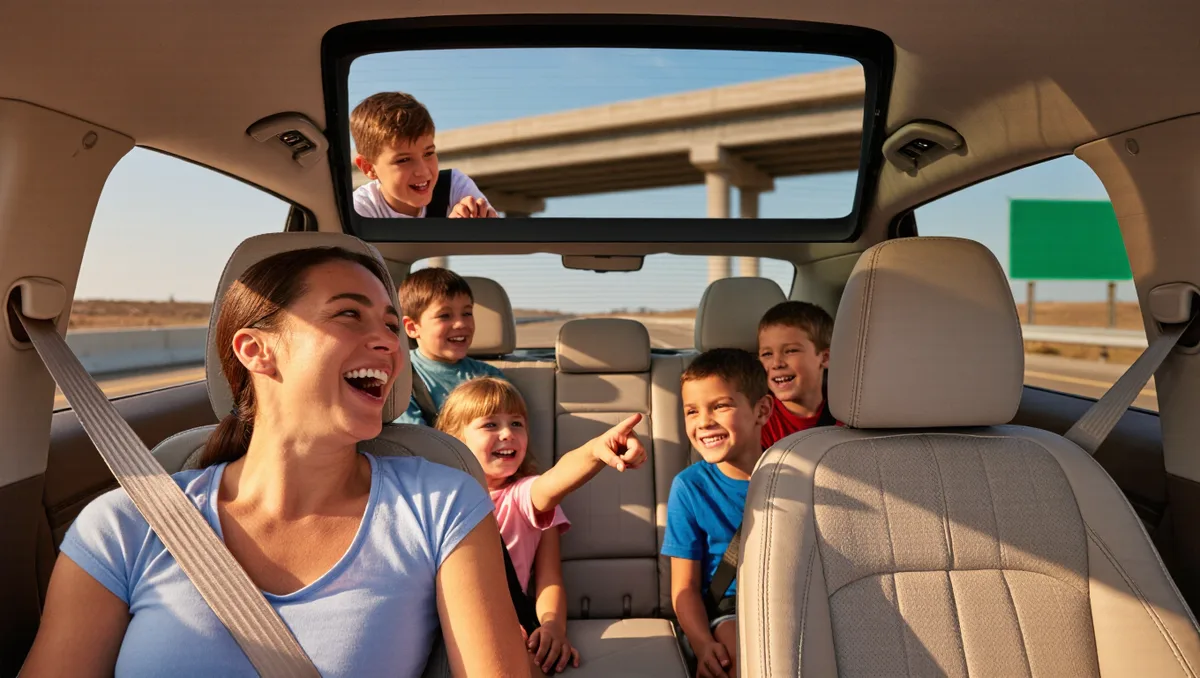
Yes — you can keep kids entertained for hours in the car with nothing but words, memory, and a little friendly competition. The best road trip games for kids in this guide need zero supplies: no cards, no printouts, no activity bags wedged between the seats. They work from the front seat to the third row, and they reset with a new round whenever the novelty fades.
The trick is matching the game to the age and the attention span. A four-year-old can sustain a round of I Spy for a good stretch; a ten-year-old will burn through it fast and want rules with stakes. Below, each game is grouped by age range, with a note on how long it tends to hold before you should rotate to the next one — and a warning about the step where things usually go wrong.
If you want the full kit — audio options, snack timing, screen windows — our Road Trip Entertainment for Kids: The Age-by-Age Survival Guide covers the whole trip. This article is just the no-supplies layer: the games that work even when everything else is out of reach.
What makes a great zero-supplies car game?
Three things. First, no props — anything you might have to reach for from the driver's seat is a liability. Second, flexible rules, so you can stretch a round longer for a six-year-old or tighten it for a twelve-year-old. Third, a natural end point, so nobody has to adjudicate a "who wins" argument at mile 200.
It's worth pausing on that word "best." According to Cambridge Dictionary, "best" means of the highest quality — the most excellent of its kind. By that standard, the games below earn the label not because they're flashy, but because they reliably do the one job asked of them: hold a mixed-age carload's attention with nothing on hand.
Games for preschoolers (roughly ages 3 to 5)
Little kids do best with games built on noticing and repetition. These hold attention for a solid stretch before the novelty wears off, then reset cleanly.
- I Spy. The classic, and still the workhorse. One player picks something visible and gives a clue — "I spy something red." Everyone else guesses. The parent note: pick things that stay in view. A red barn is gone in two seconds; a red seatbelt buckle lasts the whole round.
- Count the [thing]. Pick an object — red cars, cows, water towers — and count them until someone calls stop. Simple, and it quietly builds number skills.
- Sing-along call and response. One person starts a familiar song and stops mid-line; the next person has to finish it. Works even with kids who can't read yet, and burns zero supplies.
Where it goes wrong: preschoolers will argue that a dark-blue car counts as "blue." Decide before you start — anything counts, or the spy's word is final. That one rule saves ten minutes of negotiation.
Games for early elementary (roughly ages 6 to 8)
At this age, kids can hold a rule in their heads for a whole round and love a game with a score. These three hit that sweet spot.
- Twenty Questions. One player thinks of an animal, person, or thing. Everyone else gets twenty yes-or-no questions to find it. This is the first game on the list where kids genuinely get better with practice — you can hear them learn to narrow categories.
- The Alphabet Game. Spot letters A through Z, in order, on signs, plates, and billboards. First to Z wins. It turns scenery into a scoreboard, which is exactly what this age wants.
- Two Truths and a Lie. Each player states three "facts" about themselves; the others guess the lie. Keep the topics light — favorite foods, pets, vacations — and it's a genuinely good way to learn something about your own back seat.
Where it goes wrong: Twenty Questions stalls when the guesser forgets what's been asked. Appoint one kid as the question-counter. It's a job, it's an honor, and it keeps the round moving.
Games for tweens and teens (roughly ages 9 and up)
Older kids want games with real stakes and room to be clever. These hold attention the longest of anything on this list — often long enough that adults want to keep playing after the kids stop.
- The License Plate Game. Spot plates from as many states as possible. It's the marathon game of the genre: it can run the entire trip, with check-ins whenever someone spots a new state.
- Story building. One person starts a story with a single sentence. Each player adds one sentence in turn. The comedy writes itself, and the rule that you must build on what came before keeps everyone listening.
- Categories. Pick a category — cereals, city names, movie characters. Players take turns naming one until someone repeats or stalls. Add a letter or a theme to make it harder for sharp teens.
- Would You Rather. Pose two absurd options, everyone picks, and the fun is defending the choice. Zero supplies, infinite rounds, and it scales from silly to genuinely philosophical with older teens.
Where it goes wrong: story building collapses when one player hogs the plot. Enforce the one-sentence rule strictly for the first few rounds; loosen it once the rhythm is set.
Mixed-age carloads: games that span the whole back seat
When you've got a four-year-old and a twelve-year-old in the same vehicle, pick games where the little one can contribute without winning on skill.
- Rhyme time. One player says a word; each player in turn must rhyme with it. A three-year-old can play; a teen can be challenged to keep it going past the obvious words.
- Lucky dip questions. The front seat asks one question at a time — "What's the strangest food you'd try?" — and every passenger answers, youngest first. No scoring, no elimination, and it doubles as actual conversation.
- Quiet game variants. For the final stretch, when everyone's frayed: the first person to stay silent for a set stretch of road wins. It's a classic for a reason, and it's the only game on this list where the prize is silence.
Our analysis across all three age groups: the games that last longest share one structure — a clear, repeatable turn order and a scoreboard everyone can see in their heads. Games built on guessing alone burn out fastest. If you're planning a longer outing beyond the car, the same turn-based logic is why structured formats work so well elsewhere, from a Family Feud at Home: How to Run Your Own Game Show Night setup to a rainy-day rotation of Rainy Day Indoor Activities for Families, No Screens.
How to keep any of these games alive past hour one
Every game here has a novelty shelf life, and the fix is rotation, not invention. Run a game until interest dips — you'll hear it in the answers getting lazier — then switch, and don't return to the first game until at least two others have had their turn. Coming back to a game after a break makes it feel new again.
A few practical steps that hold up:
- Front-load the physical games. Alphabet hunts and license plate spotting work best in daylight; save word games for after dark.
- Give every kid one job — scorekeeper, question-counter, letter-spotter. Ownership buys attention.
- Let the driver opt out gracefully. Several of these games run fine with the driver as a listener only.
- End rounds on a win, not a stalemate. A clean finish makes the next round easy to start.
Zero-supplies car games won't carry a ten-hour drive alone, and they don't need to. They're the layer that works when nothing else is within reach — and, as the Cambridge Dictionary's definition of "best" implies, the highest-quality option is the one that does exactly what it promises. These do.