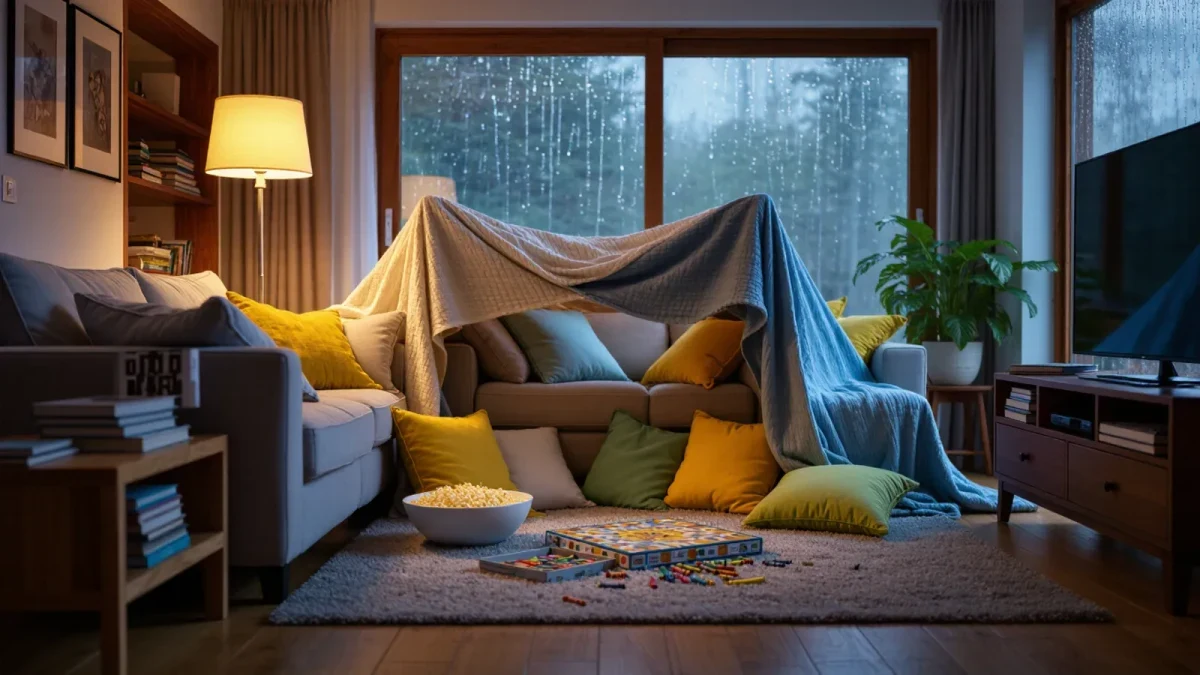
The best rainy day indoor activities for families are already in your house: a blanket fort kit, a kitchen baking project, a hallway obstacle course, and a rotating box of mystery challenges. When rain cancels the park, the trick is not to invent entertainment from scratch but to pull a pre-chosen activity from a short age-sorted list, start it within five minutes, and let it run. Screen-free rainy day fun works best when the decision is fast and the materials are ordinary.
Why do rainy days feel so hard?
Because the day loses its default. School days have structure and sunny Saturdays have the playground; a wet Saturday has neither, so every hour becomes a negotiation that ends in a screen. A short list of go-to activities, agreed on before the rain arrives, removes the decision fatigue. Write down eight to ten ideas on a card and let kids draw one slip from a jar when the sky turns gray.
What works for toddlers and preschoolers (2-4)?
Small children need sensory input and role-play, not rules. Rotate three of these per rainy day rather than offering all at once:
- Sink or float lab. A basin of water and ten household objects; guess before each drop.
- Masking-tape racetrack. Tape roads across the floor for toy cars.
- Dress-up parade. Old hats, scarves, and grown-up shoes, with a runway walk.
- Pasta threading. Dry penne onto shoelaces; instant necklace.
- Cardboard box anything. A box becomes a car, a house, or a robot with a marker.
What works for early elementary kids (5-8)?
This age runs on projects and mild competition. The strongest options use twenty minutes of focus and end with something to show:
- Indoor obstacle course. Couch cushions, painter's tape lines, a crawl under the table; time each other.
- Baking from a simple recipe. Banana bread or flatbread, with jobs for every helper.
- Homemade bowling. Ten plastic cups and a soft ball; keep a score sheet.
- scavenger hunt. Ten clues leading to a snack prize, written in ten minutes.
- Freeze dance and musical cushions. Twenty minutes of pure energy burn.
What works for tweens and teens (9-14)?
Older kids opt in when the activity treats them as capable. Give real stakes and real roles:
- Family cook-off. Two teams, same three ingredients, parents judge.
- Escape-room-in-a-box. Sequential riddles locked to a kitchen timer, or a store-bought escape game.
- Stop-motion or short film. Toys plus a phone camera counts as creation, not consumption, when there is a script and a premiere screening.
- Tournament bracket. Best-of-five in a favorite board game or table tennis, with a paper bracket on the wall.
Which activities work for mixed ages at once?
A rainy day table solves the gap problem. Set one base activity with jobs at every level: baking (a 4-year-old pours, an 8-year-old measures, a 12-year-old runs the oven timer), a giant floor puzzle with a section per child, or fort-building where the teen is the structural engineer and the toddler decorates. Team-based guessing games like charades or Pictionary-style draws also scale naturally, since a little one can team with an adult.
How much setup is too much?
Cap prep at ten minutes. Activities that need a craft-store run die on rainy days; activities built from blankets, tape, flour, and cups happen. Keep a rainy day box in a closet with the non-perishables inside: painter's tape, balloons, playing cards, dice, a pad of clue paper, and a deck of challenge cards you write once. The box makes the rainy day feel like an event instead of an emergency.
How do you keep the peace?
Three house rules carry most rainy days. First, announce transitions five minutes before they happen; moving from forts to baking goes badly when sprung. Second, keep snacks on the schedule, because indoor chaos usually masks hunger. Third, end the day with a calm anchor, a shared movie-free wind-down like reading aloud or a simple card game, so bedtime arrives without a fight.
Rainy days are not a problem to survive but a slot to fill, and filling it takes a list, a box, and five minutes of setup. Build the jar of slips this weekend, and the next gray Saturday becomes the afternoon your kids ask to repeat.
Which indoor activities work best for each age group?
Rainy-day boredom hits differently at every age, so the toolkit should too. Matching the activity to the kid — instead of forcing one plan on everyone — is what keeps a stuck-inside day from curdling.
- Ages 3–5: blanket forts, sensory bins with dry rice or pasta, freeze dance, simple shape hunts around the house
- Ages 6–9: scavenger hunts with written clues, baking with measuring jobs, DIY bowling with plastic bottles
- Ages 10+: cooking a full meal, tournament-style board games, stop-motion videos with toys and a phone
When ages span wide, pair an older kid with a younger one on a shared task. The senior partner gets responsibility and the junior gets a cool teammate, which buys you twenty minutes of peace at minimum.
How do you stage an improvised family theater show?
Improv theater costs nothing and fills an entire afternoon. Open the dress-up box or a closet of old clothes, drag chairs into a row facing the couch, and declare it a stage. The oldest participant can emcee while everyone else takes turns performing thirty-second scenes built from audience suggestions.
Keep the prompts tiny: an animal, a place, a problem. "A penguin stuck at the dentist" is a complete script as far as kids are concerned. Applaud everything, film nothing unless asked, and end with a full-cast bow. The performance is the point; polish is beside it.