Anyone can read a film like a critic by watching three things on purpose: the shots, the cuts, and the camera moves. Shots are the building blocks, cuts join them, and camera moves steer attention. Reference guides from Wikipedia's film entries lay out the whole toolkit in plain terms.
This guide breaks the skill into three habits anyone can learn: naming the shot, watching the cut, and tracking the camera. Everything here comes from reference entries on shots, film editing, and cinematography, so family film night can double as a film class with zero homework. This connects to our earlier piece, Book to Film Adaptations: A Read-First Family Guide.
What Counts as a Shot
A shot is a series of frames that runs for an uninterrupted period of time, per Wikipedia's shot overview. On a set it lasts from the moment the camera starts rolling until it stops. In the edit, a shot is simply the footage between two cuts.
Field size names how much of the subject fills the frame. The same entry lists the long or wide shot, often used as an establishing shot, the full shot, the medium shot ending near the waist, and the close-up showing the shoulder line. Try naming each size as it appears on screen.
Why Cuts Do the Storytelling
Film editors combine shots into the sequences that become a finished film, and Wikipedia's film editing entry calls their craft the invisible art, because good work keeps viewers lost in the story. Around 1918, Russian director Lev Kuleshov proved the point with one experiment, per the same entry.
The entry explains that Kuleshov intercut an old headshot of an actor with a bowl of soup, a child playing with a teddy bear, and an elderly woman in a casket. Viewers praised the hunger, the delight, and the grief in a face that never saw any of it. Juxtaposition alone did the storytelling.
The same entry traces continuity editing to the early 1900s, when consistent costumes, props, and pacing kept stories flowing. Its 180-degree rule keeps characters on consistent sides of the frame from cut to cut, so nobody in the audience wonders why the heroes switched seats mid-chase.
What Each Camera Move Tells You
Wikipedia's cinematography entry lists the core moves. A pan rotates the camera horizontally from a fixed position to follow a subject or reveal a wide view. A tilt rotates it vertically. A zoom changes the lens focal length, making a subject look closer or farther without the camera moving at all.
- Pan: a horizontal rotation from a fixed point, used to follow a moving subject.
- Tilt: a vertical rotation from a fixed point, good for showing a subject's height.
- Zoom: a lens change that creates a sense of intimacy or distance.
- Truck: the whole camera slides horizontally alongside the action.
- Pedestal or boom: the whole camera moves vertically through the scene.
The entry credits camera movement with boosting the visual quality and impact of a film. Watching for one move at a time keeps it fun. Pick pans tonight, zooms tomorrow, and the vocabulary builds fast once the eyes know what to chase.
How to Practice on Family Movie Night
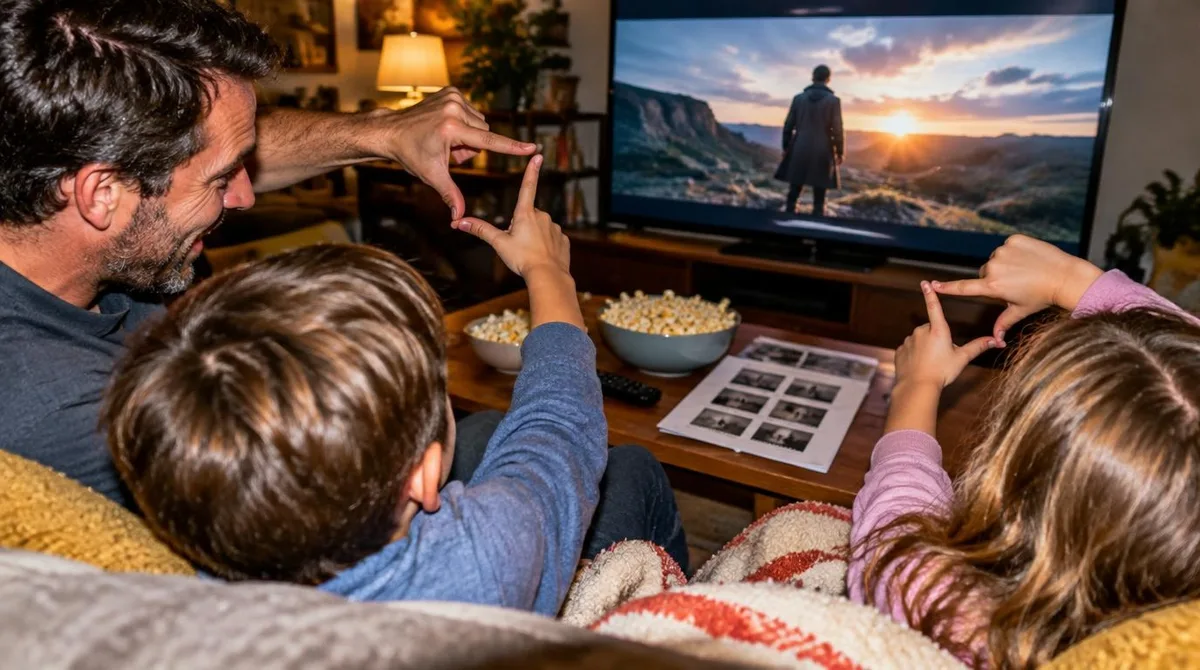
Pick one scene and watch it twice. First pass, count the cuts in thirty seconds. Second pass, name the field size of every shot and call out any camera move. Three habits turn an ordinary screening into film class, and Wikipedia's film entries supply the vocabulary for free.
A family scorecard works well. One person tracks cuts, another names shot sizes, and a third calls pan, tilt, or zoom. Whoever spots the establishing wide shot first picks next weekend's film. The rules stay simple, the popcorn stays warm, and the credits roll on a sharper eye. For related coverage, see Family Film Trilogies: The Weekend Marathon Guide.
Conclusion: A Toolkit That Works on Any Movie
Reading a film comes down to three questions. What fills the frame, and what size is the shot? Where did the cut land, and what did it hide or reveal? Where is the camera going, and why? Wikipedia's film reference entries name every tool a critic uses.
None of this needs film school or fancy gear, just attention. Name the shots, watch the cuts, track the camera, and a favorite movie turns into a masterclass on rewatch night.