Most scary movie scenes in family films are easy to predict once you know where to look. The official rating and its content descriptors, a parent-focused preview, and a two-minute trailer check will flag nearly every intense, sad, or frightening moment before your child sees it. The trick is knowing which signals matter for your particular kid.
A PG rating does not mean "no scares." It means the ratings board judged the film suitable for general audiences with parental guidance suggested — and that judgment says nothing about whether a swooping shadow, a parent's death, or a thundering villain will land hard in your living room. Tone is a family-by-family call, and this guide shows you how to make it in advance rather than mid-scene.
Our film section covers film guides built on official ratings and named sources, and this one stays practical: what the labels tell you, what they leave out, and how to fill the gap yourself.
What does the official rating actually tell you about scary content?
Start with the rating and, more importantly, the descriptors that come with it. In the United States, the Motion Picture Association assigns G, PG, PG-13, R, and NC-17, and each rated film carries brief content reasons — phrases like "mild peril" or "thematic elements." Those descriptors are the ratings system's own tone warnings, printed on the poster, the streaming listing, and the studio's press materials.
Read them literally. "Frightening images" is a direct flag. "Thematic elements" is vaguer, but it often covers grief, separation, or danger to a child character — the quiet scares that linger longer than a jump. If you want the full definitions of each rating level, our guide to What Do G, PG, PG-13, R and NC-17 Ratings Actually Mean? A Parent's Guide walks through them.
What the rating cannot tell you is intensity. Two films can both say "mild peril" and sit far apart on the fright scale. That gap is where the other tools come in.
Which preview tools flag intense scenes for parents?
Several well-established preview services describe specific scenes rather than assigning a score. Their write-ups typically itemize exactly what a worried parent wants: whether a character dies, whether a creature lunges at the camera, whether the sad part lasts thirty seconds or ten minutes. Because these sites differ in criteria, skim one and cross-check anything that matters to you.
Reviews written for families do the same job in prose. A good family-oriented review will name the tone — "the third act gets genuinely tense" — rather than just the plot. Treat that sentence as the review's most useful line, more useful than any star count.
One caution from our own standards: child-relevant safety and suitability claims should come from named organizations or clearly identified reviewers, not anonymous comment threads. A forum post saying "my five-year-old was fine" is an anecdote, not a preview.
How do you screen a trailer in two minutes?
Trailers are edited to sell the film, so they can oversell the comedy and undersell the dread — but they are still the fastest check available. Watch with these questions in mind:
- Does the trailer lean on darkness, thunder, or a low, rumbling score? Music is where a film's true tone leaks out.
- Do any shots show a child character alone, chased, or crying? Those beats predict the emotional heavy scenes.
- Is there a villain with a design built to frighten — a mask, a silhouette, sudden movement?
- Does the trailer itself startle you? If the two-minute version made you flinch, the full film will not be gentler.
If the trailer is ambiguous, a studio or theater clip reel, a scene excerpt posted by the studio, or a "first ten minutes" style preview will settle it. Ten minutes of the real thing beats any description.
What kinds of scares show up in family films?
Knowing the standard catalog of kid-movie intensity helps you name what you are screening for. Most fall into a few familiar buckets:
- The jump scare. A sudden image paired with a sudden sound. It startles anyone and can genuinely rattle younger viewers, even in a comedy.
- The villain reveal. A character who seemed friendly turns threatening, often with a visual change — glowing eyes, a distorted voice.
- The peril sequence. A chase, a fall, a storm, a collapse. Fast cutting and loud sound do the frightening work.
- The loss scene. A parent or pet dies, or a family separates. No imagery to fear, but often the heaviest moment in the film — and the one the ratings descriptors gesture at with "thematic elements."
- The sustained dread. The rarest in family films, but real: long stretches where something unseen may appear. This is the engine of adult horror, and it explains why some kids' films feel scarier in memory than in any single scene.
That last category is worth understanding even if your household never crosses into true horror. As the genre's own guides describe it, horror as a form runs on both slow-burning suspense and quick jump scares — the difference between a creeping sense that something is wrong and a single loud lunge. Family films borrow the milder end of both tools, which is why a "scary" kids' movie may unsettle through atmosphere rather than any one moment. Readers following this should also see 2026 Family Movie Release Calendar: Every Animated and Kids' Film Dated So Far.
For context on where the genre goes at full strength, Rotten Tomatoes maintains a ranked guide to the 200 best horror movies of all time, spanning German expressionism, Universal monsters, slashers, and psychological chillers — a useful map of the far end of the fright spectrum, and a reminder of how much distance there is between a PG peril scene and the genre's real heavyweights.
How should you match a film to your child's sensitivity?
You know your child better than any ratings board does. The useful question is not "is this movie scary?" but "which of these scare types does my child handle well, and which do they carry to bed?" Some kids shrug at monsters and dissolve at a sad dog. Others laugh through peril and flinch at shadows. Build the picture from what you have already watched together. This connects to our earlier piece, A Minecraft Movie Opened to a Record — and a PG Rating Families Should Know.
A few practical habits, drawn from how experienced families handle this:
- Preview the heavy beats yourself first. A phone-checked scene list takes less time than a recovery night.
- Watch the first viewing together. Your presence converts a scare into a shared moment.
- Name the technique. Telling a child "that loud sound is there to surprise you — the filmmakers added it" demystifies the jump scare remarkably well.
- Pause is a tool. Streaming makes the sad scene stoppable. Use it without apology.
- Leave the ending warm. If a film ends dark, follow it with something light the same evening.
Our analysis: the biggest predictor of a bad movie night is not the film's intensity but the mismatch — a sensitive child handed a peril-heavy comedy, or a thrill-seeking kid handed something too gentle, both end in restlessness. Screening for tone, not just rating, is what fixes it.
What this means for your next family movie night
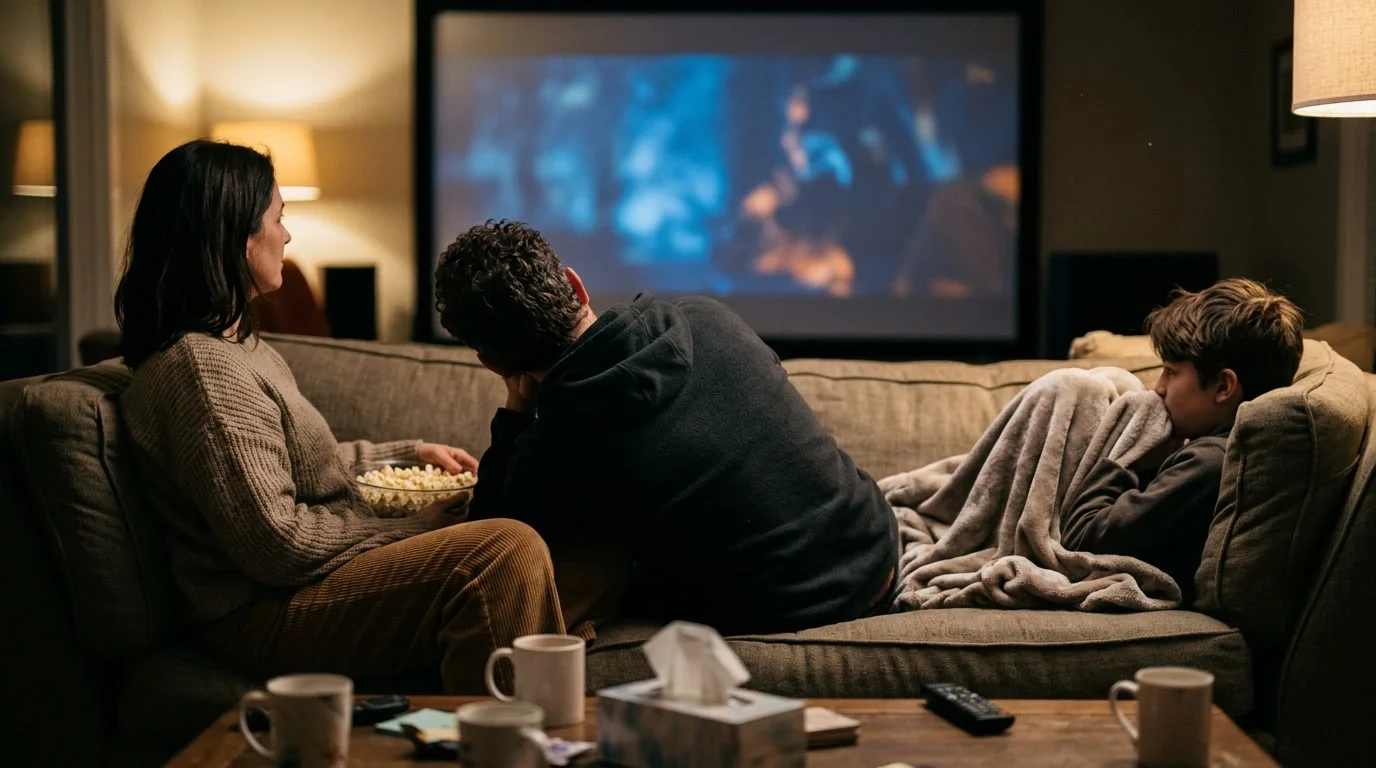
The evidence here is straightforward: the ratings board gives you the descriptors, the preview services give you the scene-level detail, and the trailer gives you the tone in real time. None of these tools requires more than a few minutes, and together they answer the question every parent actually has — not "is this a good movie?" but "will this movie sit well with the kid on my couch?"
What remains unknown, always, is your child's reaction on the night. Sensitivity shifts with age, mood, and even the darkened room itself. The preparation narrows the risk; it cannot remove it. That is fine. A well-chosen film, watched together, with a pause button within reach, turns even the scary movie scenes into something a family can talk about afterward — which is, in the end, the best outcome a movie night can have.