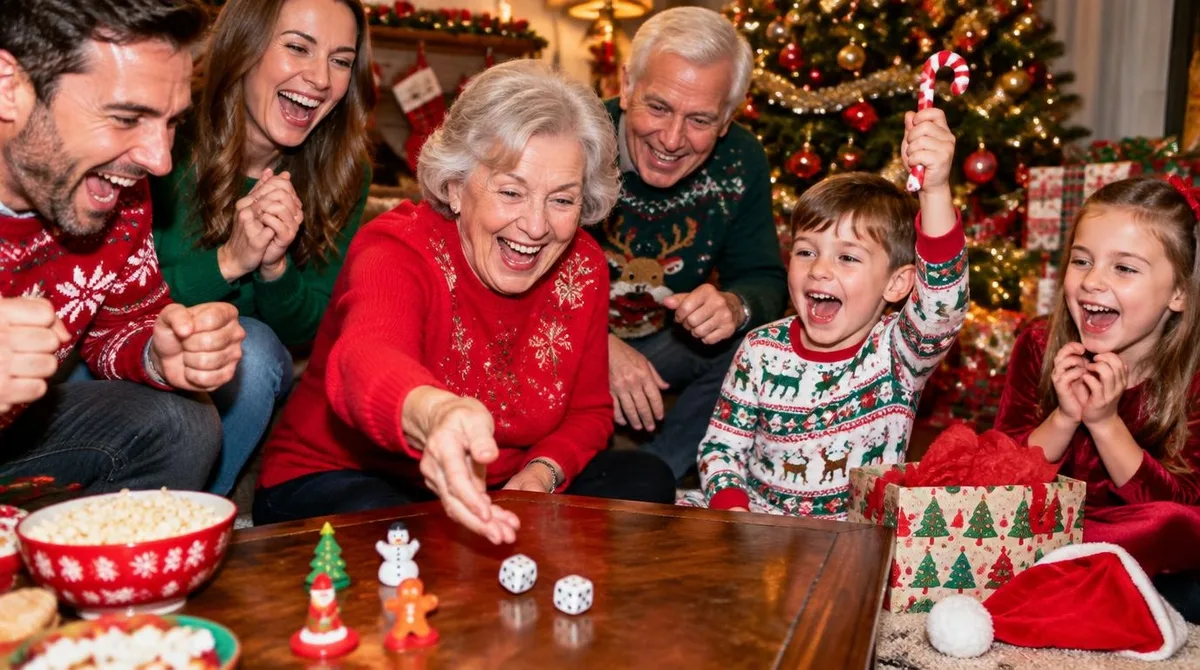
The best christmas games for family gatherings share three traits: they need almost no setup, they welcome every age in the room, and they survive a crowd that includes both a six-year-old and a grandfather who claims he doesn't play games. This guide rounds up the reliable ones — indoor and outdoor — with the supplies, group sizes and age notes for each, so you can pick two or three and stop planning.
One honest note up front: no game works for every family. What follows is built on what each game actually asks of its players — materials, space, patience — the same way you'd read the spec sheet before buying a used car. If your crew hates acting things out, skip the charades entries. Nobody needs a game that turns Christmas afternoon into a negotiation.
If the gathering runs long, a couple of these pair well with other low-key plans. Our Rainy Day Indoor Activities for Families, No Screens list covers the quieter stretches, and the Multigenerational Game Night guide handles the age-spread problem in more depth.
What makes a game work at a family gathering?
Three things decide whether a game survives the living room. First, rules that can be explained in under two minutes — anything longer and half the table wanders off. Second, no fixed team size, because your headcount changes when the cousins arrive late. Third, a way for quieter family members to join without performing. Games that fail one of these tests tend to end early, and that's fine. It just means you needed a backup, which is why this list runs from zero-supply classics to a few store-bought options.
Which indoor games need no supplies at all?
These are the ones you can start the moment someone says "we're bored," with nothing but people in the room.
- Christmas charades. Write holiday prompts on slips of paper — decorating the tree, shoveling snow, untangling lights. All ages can play if the youngest players get simpler prompts. Works with four people or fourteen.
- Twenty Questions, holiday edition. One person thinks of a Christmas-related thing. Everyone else gets yes-or-no questions. Great for mixed ages because little kids guess wildly and that's part of the fun.
- Two truths and a wish. Each person shares two true things about their year and one thing they hope for. It's not competitive, which makes it a good wind-down game after dinner.
- Silent-night storytelling. One person tells a holiday story aloud while the others try to keep straight faces; the first to laugh tells the next one. Simple, silly, and it gives the teenagers something to win.
The common thread: none of these needs a table, a screen or a trip to the store. That's the whole selling point.
What can we play with paper and a pen?
A stack of index cards and a couple of pencils unlock the next tier. These games take a little more structure but reward it.
- Christmas Pictionary. Same prompts as charades, but drawn. Teams of two or more. The laughter comes from the drawings, not the guessing, so artistic skill genuinely doesn't matter.
- Guess-the-drawing relay. One person draws, one person guesses, then the guesser becomes the next artist. Keeps everyone rotating in.
- Family trivia. Write questions about the family itself before the gathering — who broke what, who went where. This is the single highest-return game on the list for gatherings where relatives see each other once a year, because the material is already personal.
- Christmas word scramble. Hand out sheets with holiday words jumbled. First to finish wins. Good as a table-settler while dinner finishes cooking.
If your family likes the game-show format, our Family Feud at Home guide shows how to run a full survey-style round with nothing fancier than a scoreboard and a confident host. For related coverage, see Family Feud at Home: How to Run Your Own Game Show Night.
What works outdoors or in a big room?
If you have a yard, a basement, or simply a house where running is allowed, these burn off the post-dinner energy.
- Gift-wrap relay. Teams race to wrap a box — with mittens on. The mittens are the game. Kids find this hilarious and adults find it humbling.
- Snowball target toss. Real snowballs outside, or rolled socks inside, aimed at buckets or bowls at increasing distances. Score it like carnival games. Adjust distances for age and nobody gets left out.
- Freeze dance, holiday playlist edition. Music plays, everyone dances, music stops, everyone freezes. Last one moving sits out. Works from about age three up, and it costs nothing.
- Candy cane hunt. Hide candy canes around the yard or one room. Little kids get a head start; older kids and adults hunt the hard-to-reach ones. The staggered start is what makes it fair across ages.
Where things usually go wrong: outdoor games die the moment someone gets cold. Keep rounds short, rotate people inside, and have the indoor list ready as the fallback. A game plan with no backup plan is how gatherings go quiet at four in the afternoon.
Are store-bought games worth it for the holidays?
Sometimes. A good boxed game earns its shelf space if it plays in under an hour and handles a wide player count. The classics — the word-guessing party games, the drawing games, the deduction games — keep earning their spot because their rules are already known by half the room, which cuts teaching time to zero. Before you buy anything as a gift, check availability early; retail stock shifts constantly in December, and as Best Buy's own store guidance notes, product availability can change throughout the holiday season, so checking back early is the practical move. If you're building a shelf for the whole year rather than one weekend, our Starter Family Board Game Collection guide sorts the durable picks from the shelf warmers.
What this means for your shopping: buy one boxed game at most, and lean on the zero-supply list for the rest. The games people remember from childhood gatherings are almost never the ones that came in a box.
How do you keep every age included?
The trick is pairing and roles, not special kid games. Put a young child on a team with a patient adult. Give teenagers jobs — scorekeeper, host, judge — that come with real authority. Let grandparents run the trivia, because they hold the family memory the questions come from. A game that feels like a chore to one age group will drag the whole room down, so rotate through two or three short games rather than committing the afternoon to one.
And set the prize expectations early. Small, silly, equal-ish prizes — first pick of dessert, the good seat, the last candy cane — keep competition friendly. Nothing sours a gathering faster than a teenager who lost a candy cane hunt to a nine-year-old and won't let it go.
Our analysis: the two-game plan
Here's the verdict, same format as always — who this works for, who it doesn't, and what it costs. Run exactly two games: one zero-supply game right after dinner, when everyone is seated anyway, and one active game about ninety minutes later, when the room needs to move. That's it. The families who try to schedule a full slate of games burn out the room by mid-afternoon; the families who plan nothing get three hours of screen-staring. Two games, spaced apart, hits the sweet spot. It costs nothing, needs no shopping trip, and the only skill required is knowing when to stop — which, like most things at a family gathering, is the hard part.
For more ways to build the day around the people in it, start with the Family section, where the gathering-planning guides live alongside the game coverage in Games.