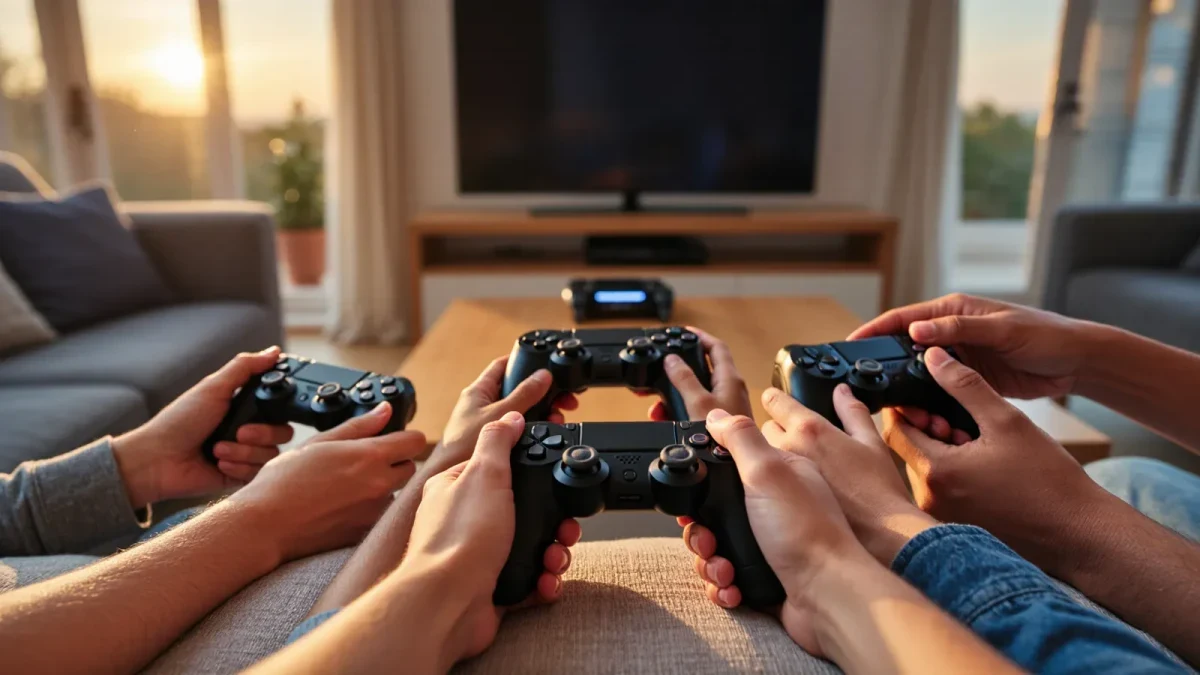
The co-op games that genuinely teach kids teamwork share one design trait: they are unwinnable alone. Overcooked! 2 (E10+, 4 players) forces players to divide a kitchen and talk through orders; It Takes Two (T, 2 players) makes every puzzle solvable only by two people doing different jobs at the same time; Lovers in a Dangerous Spacetime (E10+, 4 players) puts each player in charge of one station of a single shared spaceship; and Minecraft (E10+) turns teamwork into long-horizon building projects. Each game trains a different teamwork muscle — communication, role specialization, trust, and shared planning — and all four can be played together on the couch rather than online with strangers.
What actually makes a game teach teamwork?
Competitive games teach gracious losing, which is valuable but different. Cooperative games teach something rarer: succeeding through someone else. Three design elements do the teaching, and you can check for them on any store page before buying:
- Interdependence — the game physically cannot be completed by one skilled player carrying everyone. If a pro can solo it, the teamwork lesson evaporates.
- Asymmetric roles — different players do genuinely different jobs, so nobody is redundant and nobody can hide.
- Time pressure with a shared goal — a clock forces the group to organize itself: who leads, who supports, who calls out what's next.
The magic ingredient is the post-failure debrief. The games below all fail loudly and hilariously, which is precisely what triggers the "okay, new plan" conversation — the moment teamwork is actually learned.
Why is Overcooked! 2 the communication trainer?
Overcooked! 2 (E10+, 1-4 players, on Switch, PlayStation, Xbox, and PC) is chaos engineering for families: four chefs, one kitchen, orders arriving on a timer, and obstacles like moving trucks between stations. One skilled player cannot cook four dishes alone — the design makes delegation mandatory. Families quickly discover the difference between shouting "I need tomatoes!" and assigning jobs calmly, and the game rewards the second within a level or two. The single most common review-theme from parents about this game, consistent since its 2018 launch, is that it revealed — and then improved — how their family communicates under pressure. Two or three rounds is a complete session; it pairs perfectly with a discussion over dinner about what the kitchen needed.
Why does It Takes Two teach role specialization?
It Takes Two (T for Teen, exactly 2 players, on Switch, PlayStation, Xbox, and PC) — winner of Game of the Year at The Game Awards in December 2021 — hands the two players different abilities in nearly every level: one might have matches while the other has a watering gun, and every puzzle requires both, in sequence or simultaneously. That is the textbook structure of role specialization: your value comes from being different from your partner, not better than them. It is best suited to a parent-and-teen or sibling pair, and a full playthrough takes roughly a dozen sessions — effectively a semester-long teamwork course disguised as entertainment, with a story about repairing a relationship at its center.
What makes Lovers in a Dangerous Spacetime special?
Lovers in a Dangerous Spacetime (E10+, 1-4 players) is the purest interdependence game on this list. Up to four players crew one round spaceship, each running to different stations — helm, shields, weapons, engines — through neon-dangerous space. Nobody can be everywhere at once, so the crew must call stations to each other constantly: "take shields, I've got the wheel." Younger kids play a real, needed role without needing fast reflexes, and the ship survives or dies as a single unit. There is no scoreboard with individual scores — an underrated feature for sibling harmony. It is the best first co-op for families with a 6-to-10-year-old, and the station-calling habit it builds transfers directly to team sports and group projects.
How does Minecraft become a teamwork game?
On paper Minecraft (E10+, split-screen on Switch, PlayStation, and Xbox) is a solo sandbox. In practice, a family survival world becomes a shared planning exercise: someone mines, someone farms, someone builds the house, and the division of labor is entirely the players' own invention — no game designer assigning roles. That self-organization is the lesson. Long-horizon projects (a castle, a railway, a farm tower) teach kids that cooperation compounds: the world gets more impressive the longer the team works together, week after week. Keep it local — split-screen on the couch or a family-only realm — and the teamwork happens inside your supervision rather than out in public servers.
Which game fits which age and skill mix?
| Title | ESRB | Players | Teamwork skill | Best for |
|---|---|---|---|---|
| Lovers in a Dangerous Spacetime | E10+ | 1-4 | Constant communication | Ages 6-10 entry co-op |
| Overcooked! 2 | E10+ | 1-4 | Delegation under pressure | Ages 8+, high energy |
| Minecraft (family world) | E10+ | 2-4 local | Long-term planning | All ages, calm sessions |
| It Takes Two | T | 2 | Role specialization | Ages 13+, parent-teen |
How do parents turn play into actual learning?
Three habits convert game time into teamwork training. Debrief for sixty seconds after a failed level — "what should we try differently?" — because reflection is where skill consolidates. Rotate roles deliberately, so the child who always drives gets a turn on shields and learns what support feels like from the other side. And let the kids run the plan sometimes; a family where the 9-year-old directs the strategy and the parents follow is a family that has genuinely learned to work as a team, whatever happens to the spaceship.