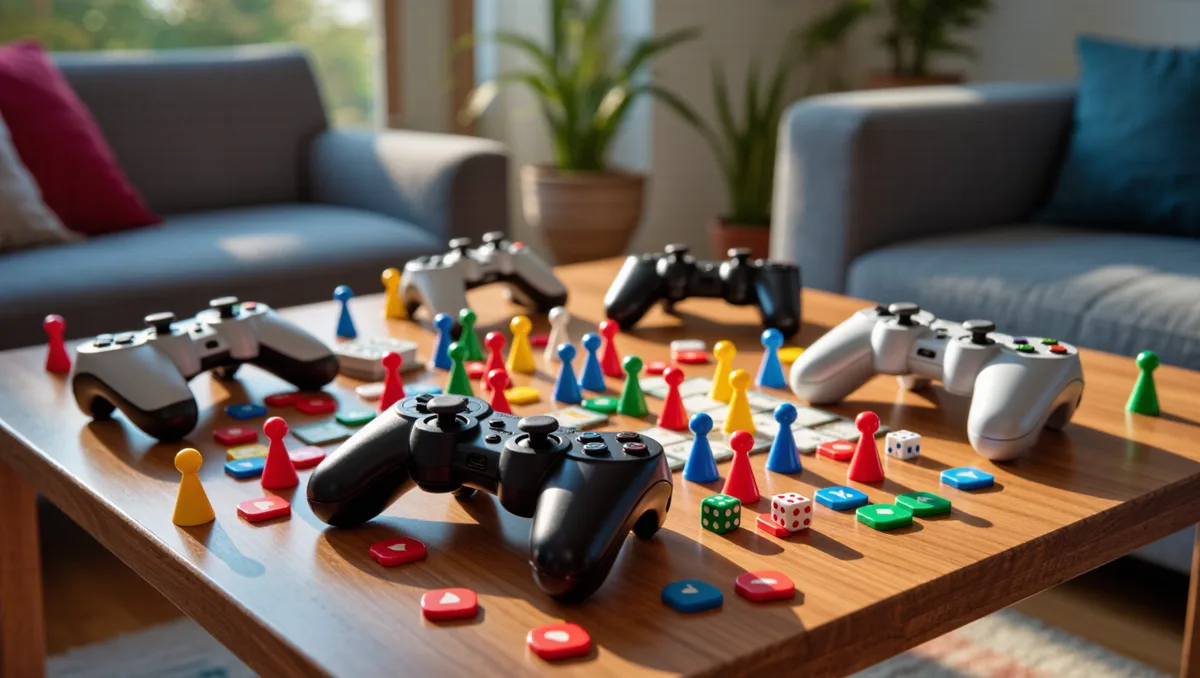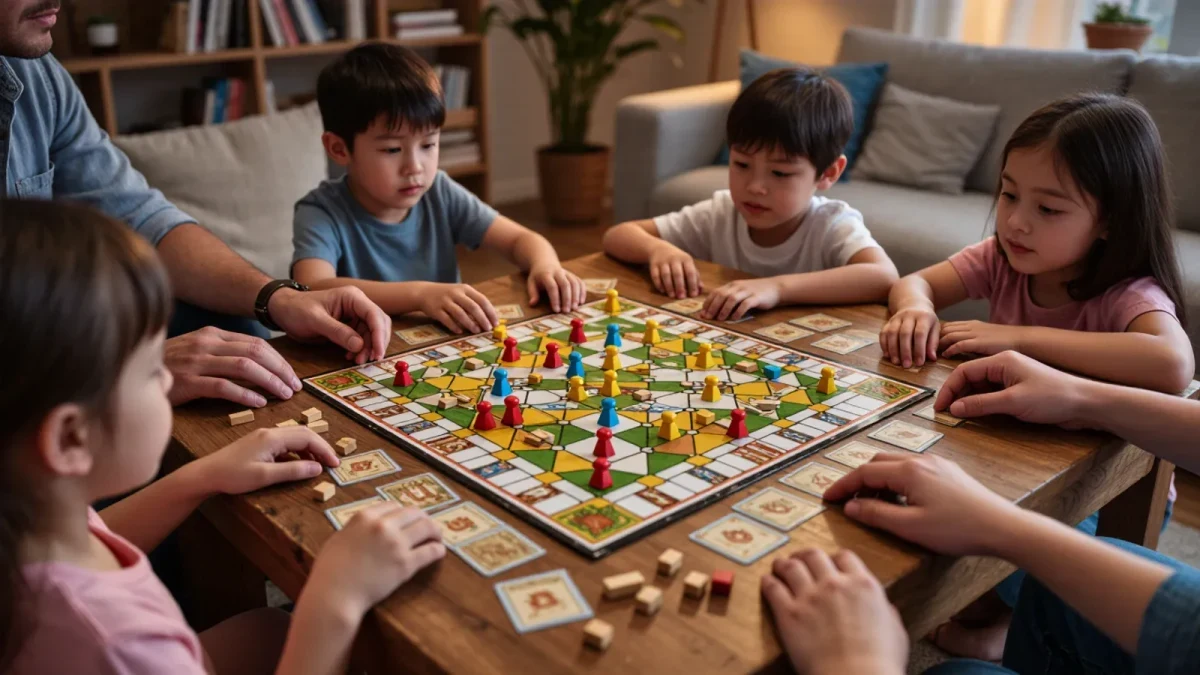
A starter family board game collection needs just nine titles: one preschool game, one cooperative game, one party game, one quick card game, one bluffing game, one word game, one strategy gateway, one tile classic, and one long-family epic. Together they cover ages 3 to adult, play in under an hour, and cost less than a single console game. This family board game collection guide lists real, award-winning titles with their manufacturer-recommended ages so you can buy once and play for years.
What should the first game for preschoolers be?
Uno (ages 6+, plays younger with help; 2-10 players, 30 minutes). Still the best first card game: color and number matching, reversible rounds, and every child's first taste of a well-timed Draw Four. Preschoolers can join a simplified color-only variant years before the printed age.
Hoot Owl Hoot (ages 4+, 2-4 players, 15 minutes). A cooperative game where everyone moves owls home together before sunrise. Co-op games are the secret weapon of family game night, because a 4-year-old cannot lose, cry, or knock over the board in defeat.
What are the best games for ages 6 to 10?
Ticket to Ride: First Journey (ages 6+, 2-4 players, 15-30 minutes). The junior version of the modern classic route-building game; kids collect train cards and claim routes across a simplified map. It teaches light strategy without reading-heavy rules.
Sushi Go! (ages 8+, 2-5 players, 15 minutes). A card-drafting game about grabbing the best sushi combination. Rounds take minutes, scoring is counting practice, and it is the easiest game on this list to teach a grandparent in one round.
Spot It! (ages 6+, 2-8 players, 10 minutes). Fifty-seven symbols, always exactly one match between any two cards. It is the travel game, the waiting-room game, and the fairest game between a 6-year-old and an adult, because adults are not actually faster at it.
What should you add for tweens and adults?
Ticket to Ride (ages 8+, 2-5 players, 30-60 minutes). The full version, a Spiel des Jahres winner and one of the best-selling modern board games ever made. Collect train cards, claim cross-country routes, block a family member's plan, and enjoy the grudge for a week.
Codenames (ages 10+, 4-8+ players, 15 minutes). Two teams, two spymasters, and one-word clues. It is the definitive party game for mixed ages, and it scales to a full house by adding players to teams.
Skull (ages 10+, 3-6 players, 15 minutes). A bluffing game of coasters and nerves: lay flowers or a skull, bid on how many you can flip, and lose it all to one brave lie. Rounds are short, loud, and instantly re-playable.
What is the one big game for holidays?
Catan (ages 10+, 3-4 players, 60-90 minutes). The game that launched modern tabletop into the mainstream. Trading, building, and dice luck keep a full table involved, and expansions extend it for years. Save it for school breaks, when bedtime is negotiable.
How do the nine games fit together?
| Game | Ages | Players | Time | Role in collection |
|---|---|---|---|---|
| Hoot Owl Hoot | 4+ | 2-4 | 15 min | First cooperative game |
| Uno | 6+ | 2-10 | 30 min | First card game |
| Spot It! | 6+ | 2-8 | 10 min | Travel and waiting rooms |
| Ticket to Ride: First Journey | 6+ | 2-4 | 20 min | First strategy game |
| Sushi Go! | 8+ | 2-5 | 15 min | Quick filler |
| Ticket to Ride | 8+ | 2-5 | 45 min | Family strategy night |
| Codenames | 10+ | 4-8+ | 15 min | Party and groups |
| Skull | 10+ | 3-6 | 15 min | Bluffing fun |
| Catan | 10+ | 3-4 | 75 min | Holiday epic |
How should a family start the collection?
Buy in two waves. Wave one for young families: Uno, Spot It!, and Hoot Owl Hoot, roughly the cost of a pizza night. Wave two as kids turn eight and up: Ticket to Ride, Codenames, and Skull, which carry game night through the teen years. Store the nine games in one accessible shelf, never the closet, because a game nobody can reach is a game nobody plays.
House rules make the collection last: the winner of each night picks the next game, everyone helps clean up before snacks, and a losing streak of three earns pick of the next title too. Start with one wave, play weekly, and the shelf fills itself.
How do you store and grow a collection?
A starter collection stays fun only if it stays playable, and that means storage you can maintain in two minutes. One shelf, games standing vertically like books so titles are readable, with card games in a single box or drawer. Horizontal stacks guarantee the game you want is always at the bottom.
Grow the collection on a schedule, not on impulse — one new game every month or two is plenty for a family still learning its favorites. Before buying, check the player count and runtime against your real crew: a four-player-only game in a five-person household creates a permanent bystander. Donate or trade games that have flopped twice; shelf space is part of the collection too.
What categories should a balanced collection cover?
A solid family shelf mixes four types, each for a different mood:
- Party games: fast, loud, big groups, zero setup — the icebreakers
- Strategy games: longer thinks for older kids and patient adults
- Cooperative games: everyone plays together against the game itself, ideal for siblings who feud over losing
- Classic card and dice games: cheap, compact, the travel and grandparents' house insurance
How do you make the first few game sessions go smoothly?
Teach the game to one or two people before the whole table sits down, so allies can help herd the rules. Read the rulebook yourself first — nothing kills momentum like a parent flipping pages mid-turn. Start with a practice round where score does not count, and let a kid win a practice hand so the losing feels survivable later.
Keep first sessions short even if that means stopping early. Ending while everyone is still laughing beats squeezing in one more round that ends in tears. The goal of night one is a request for night two.