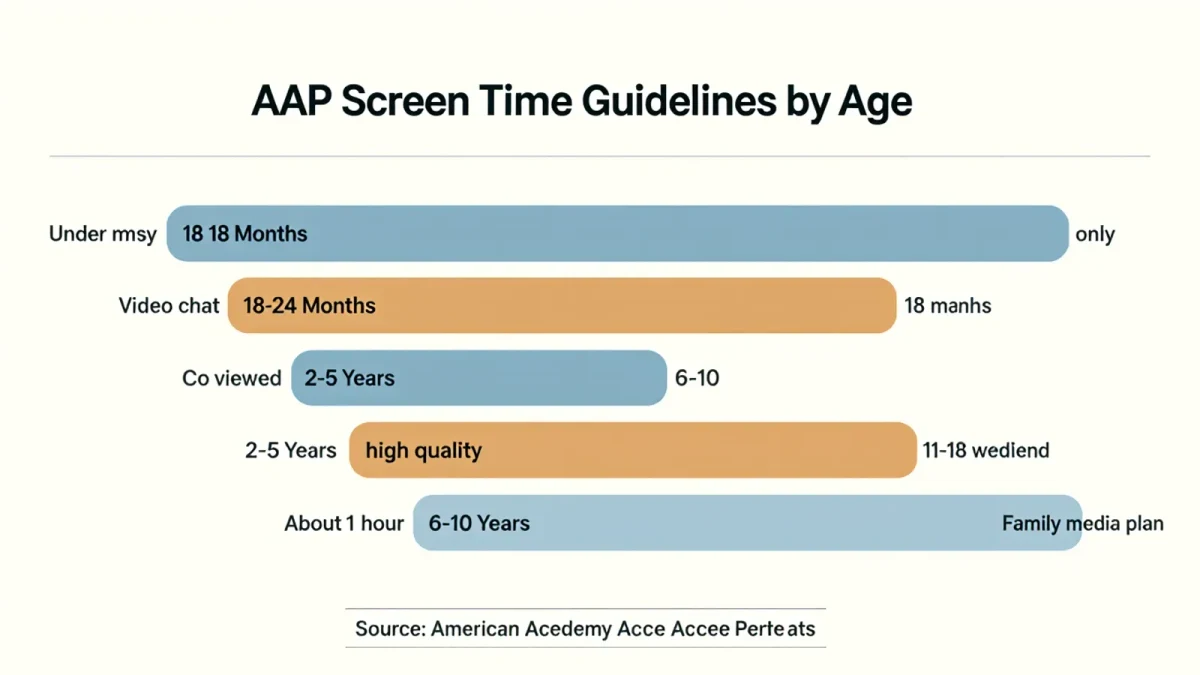
Here is what the American Academy of Pediatrics actually recommends on screen time for kids: avoid screens entirely for children under 18 to 24 months except video chatting; for ages 2 to 5, limit non-educational screen use to about one hour per weekday and up to three hours on weekend days; and for school-age children and teens, the AAP no longer prescribes a fixed hour count but calls for consistent limits that protect sleep, physical activity, and face-to-face time. Per the American Academy of Pediatrics, the focus since its 2016 media guidance update has shifted from a single magic number to the quality of what kids watch and what screens displace.
What does the AAP recommend for babies and toddlers?
For infants under 18 months, the AAP advises avoiding use of screen media other than video chatting. That exception exists because video calls with grandparents are interactive, responsive, and social, which is exactly what passive video is not. Between 18 and 24 months, if parents want to introduce digital media, the AAP says to choose high-quality programming and watch it together, so the child builds language from the interaction rather than from the screen alone.
For ages 2 to 5, the AAP's current guidance caps screen use at approximately one hour per weekday, with room for up to three hours on weekend days, and stresses co-viewing. The point is not the clock but the company: a parent narrating what happens on screen turns passive viewing into a conversation.
What changed for older kids and teens?
In 2016 the AAP moved away from blanket hour limits for school-age children and teens. Its Family Media Plan tool asks families to set their own consistent limits around four anchors: sleep, physical activity, meals, and school. The reasoning is that a teen who sleeps nine hours, plays a sport, and does homework can responsibly watch a two-hour movie on Saturday, while a teen scrolling in bed until 1 a.m. has a problem no hour-count fixes.
| Age group | AAP guidance | Practical translation |
|---|---|---|
| Under 18 months | No screen media except video chatting | Save the tablet; schedule grandma video calls freely |
| 18-24 months | If introduced, high-quality content co-viewed with an adult | Watch together and narrate; no solo handheld use |
| 2-5 years | ~1 hour per weekday, up to 3 hours on weekend days, co-viewed | Treat it like a TV block, not background noise |
| 6-10 years | Consistent parent-set limits; screens never displace sleep or play | Fixed windows, devices parked outside bedrooms |
| 11-18 years | Family Media Plan; protect sleep, activity, schoolwork, meals | Agree on rules together; no screens one hour before bed |
What is the AAP's stance on screens and sleep?
It is blunt: screens belong out of bedrooms and away from the bedtime routine. The AAP recommends stopping screen use at least one hour before bed and keeping TVs, tablets, and phones out of children's bedrooms overnight. The reason is both behavioral, since content keeps young minds alert, and practical, since devices with notifications fragment sleep. This single rule, enforced consistently, does more for family life than any hour-count debate.
What about mealtimes and background TV?
The AAP counsels turning off the television and setting devices aside during family meals. Shared meals are one of the most reliable predictors of language growth and family connection, and background media competes with the conversation children need. For infants and toddlers, the AAP specifically warns that a TV playing in the background reduces parent-child talk, which is why its guidance targets foreground use only.
How do you actually set limits that stick?
The AAP's own answer is the Family Media Plan, a free interactive tool on HealthyChildren.org that walks families through rules for each child. Practical practices that work in most households:
- Set device curfews, not debates. Screens off at a fixed time, charged in a common area overnight.
- Use built-in parental tools. iOS Screen Time and Google Family Link let you cap apps without standing over anyone.
- Watch together when you can. Co-viewing is the AAP's single most repeated recommendation for preschoolers.
- Model it. Kids notice when a parent's phone rule applies only to them.
Is all screen time equally concerning?
No, and the AAP says so explicitly. An hour of a nature documentary watched together, a video call with a cousin, and an hour of autoplaying clips are different experiences. The Mayo Clinic, which echoes the AAP framework in its own children's screen time guidance, emphasizes content quality, adult involvement, and what the screen time replaces, whether that is sleep, homework, or outdoor play. Age-appropriate screen time limits work best when they describe what happens around the screen, not just the minutes on it.
What should parents take away from all this?
Three rules cover most of the AAP's advice: no solo screens before 18 months, roughly an hour a day for preschoolers, and a family-wide media plan for everyone else that protects sleep, movement, and meals. Revisit the plan each school year, because a second grader's needs are not a seventh grader's. The AAP's message is steadier than any headline about screens: what children watch, with whom, and at what cost to sleep and play matters more than any single number.