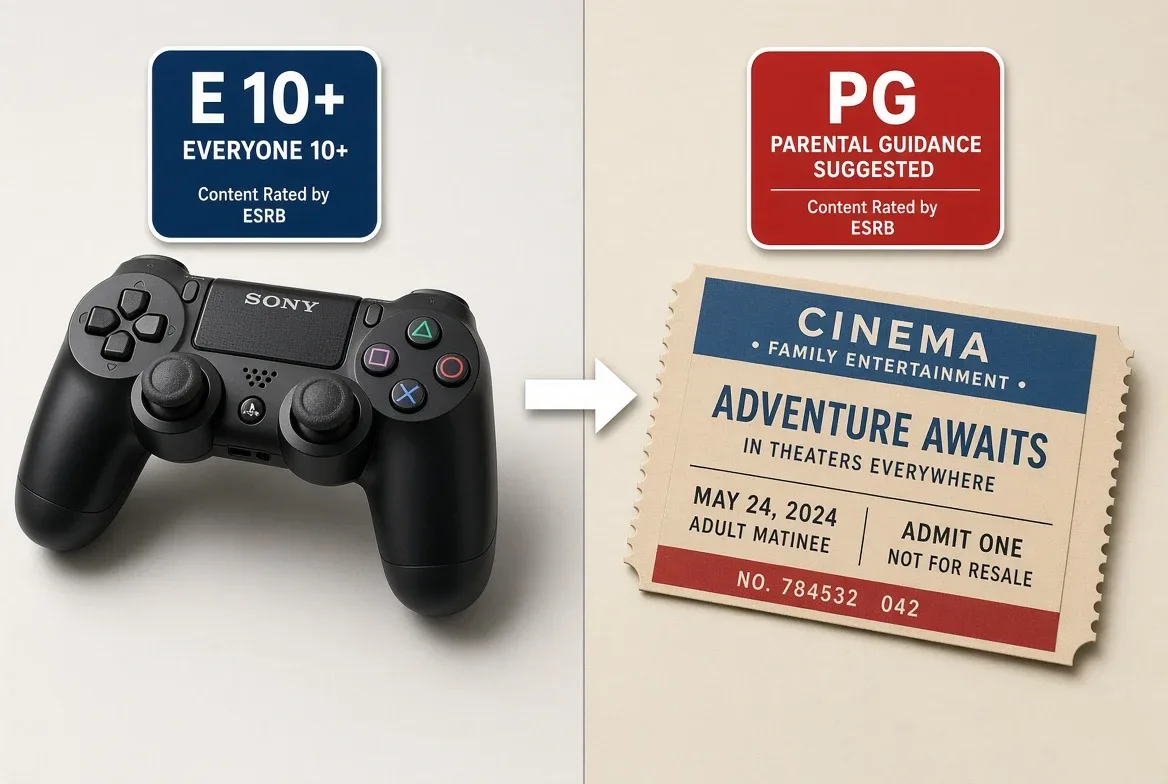
Video games are rated by the Entertainment Software Rating Board (ESRB) and movies are rated by the Classification and Rating Administration (CARA), a division of the Motion Picture Association (MPA) — two separate boards with two separate symbol sets, though CBS News notes the two systems "roughly correspond" to each other, which is why a lot of families default to comparing them side by side.
Both systems exist for the same basic reason: to give a fast, voluntary signal about content before anyone presses play. Neither one is a review, a quality score, or a legal restriction — they're content labels, assigned by boards made up mostly of parents, and it helps to know how each one actually gets built.
What do the ESRB game ratings mean?
The ESRB uses six labels. Everyone (E) covers content generally suitable for all ages, with at most minimal cartoon, fantasy, or mild violence. Everyone 10+ (E10+) allows a bit more of that plus mild language or minimal suggestive themes. Teen (T) is built for ages 13 and up and can include violence, suggestive themes, crude humor, minimal blood, simulated gambling, or strong language. Mature 17+ (M) is for ages 17 and older and can include intense violence, blood and gore, sexual content, or strong language. Adults Only 18+ (AO) is reserved for content suitable only for adults, including graphic sexual content or real-currency gambling, according to the ESRB's own ratings guide.
A seventh label, Rating Pending (RP), shows up in marketing materials for games that haven't finished the ratings process yet — it's a placeholder, not a final answer.
What do content descriptors and interactive elements add?
Underneath the letter grade, the ESRB attaches Content Descriptors — short tags for things like blood/gore, strong language, gambling themes, or nudity — that explain specifically what pushed a game into its rating category, per the ESRB's ratings guide. A separate label, Interactive Elements, flags features like in-game purchases, user-to-user interaction, or location sharing; these don't change the letter rating, but they're exactly the details a parent scanning a store page would want.
What do the MPA movie ratings mean?
Film ratings work on a five-tier scale. G (General Audiences) means all ages admitted, with nothing in theme, language, nudity, sex, or violence that would offend parents of young children. PG (Parental Guidance Suggested) asks parents to check the film before bringing younger kids, for material like brief nudity or some profanity that isn't intense enough to require a stronger warning. PG-13 (Parents Strongly Cautioned) signals that some content may be inappropriate for kids under 13. R (Restricted) requires anyone under 17 to be accompanied by a parent or adult guardian, covering adult material, hard language, intense violence, or drug abuse. NC-17 admits no one 17 or under, according to the MPA's published rating rules.
Just like the ESRB's descriptors, films rated PG through NC-17 come with their own short descriptors — the line under the rating box that explains, for example, "violence and language" — so families don't have to guess what tipped the scale.
Who actually assigns these ratings?
Film ratings come from CARA's Rating Board, which the MPA describes as an independent group made up of a chairperson, senior raters, and raters — all of them parents, none affiliated with the entertainment industry, serving terms of up to seven years. Producers submit a finished film, the board watches it, and raters cast ballots; a producer who disagrees can appeal within a set window, and overturning a rating takes a two-thirds vote, per the MPA's rating rules.
The ESRB's process runs on a comparable idea — non-industry raters reviewing submitted content — with its own descriptor and interactive-elements system layered on top, as described in the ESRB's ratings guide.
How do the two scales line up?
| Game rating (ESRB) | Roughly comparable film rating (MPA) | General audience |
|---|---|---|
| E (Everyone) | G / PG | All ages |
| E10+ (Everyone 10+) | PG | Ages 10 and up |
| T (Teen) | PG-13 | Ages 13 and up |
| M (Mature 17+) | R | Ages 17 and up |
| AO (Adults Only 18+) | NC-17 | Adults only |
Parent note: CBS News describes this pairing as a rough correspondence, not an exact match — the two boards weigh content differently, so it's a starting reference, and the descriptors underneath each rating are still worth a quick check before deciding.
What should families actually check before pressing play?
Start with the letter or box rating for the age floor, then read the descriptors underneath it — that's where the real specifics live, whether it's "blood and gore" on a game case or "violence and language" on a movie poster. For games, it's also worth glancing at the Interactive Elements line, since purchases and online interaction don't move the rating but do change what a kid can do once they're playing.
For a related entertainment news perspective, read Ben Affleck and Matt Damon Make a Splash on Gossip Stone TV.
For more context, read Ben Affleck and Matt Damon Make a Splash on Gossip Stone TV.
For more context, read tv.